
AONOS LIGHT JOURNEYS
Exploring the Inner Cosmos Through Light, Resonance & Consciousness Engineering
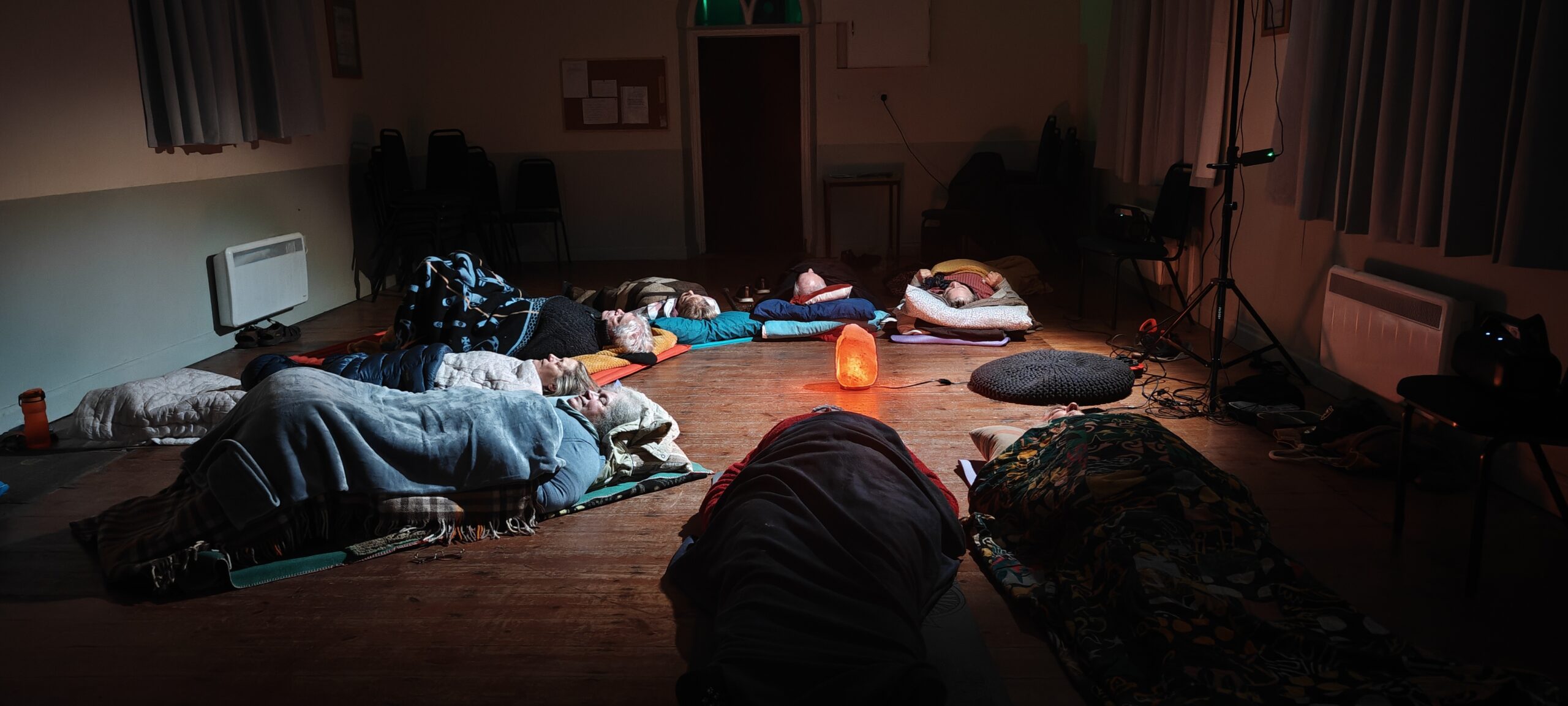
Aonos Light Journeys open a doorway into the deeper layers of the human mind. Using precision-engineered pulsed light, resonant audio, guided breathwork and somatic descent into the zone between awake and asleep, these sessions reveal the underlying architecture of consciousness — not through belief, but through physics. The beyond isn’t “out there”; it’s inside you. And the journey begins the moment the surface mind quietens and the resonance network takes over.
THE NATURE OF A LIGHT JOURNEY
Aonos Light Journeys are immersive, consciousness-shifting experiences built on the understanding that the human mind is far deeper than the version we use day-to-day. Most people operate inside the narrow top layer of awareness — the part that talks, plans, worries, reacts. Beneath that sits a far larger structure: a resonance network of memory, sensation, intuition, pattern recognition and symbolic intelligence. It’s all there, running the show, but normally hidden behind the noise of ordinary thinking.
A Light Journey temporarily reorganises this network so you can experience it directly.
Using high-frequency pulsed light, resonant audio containing embedded bio-signatures, breathwork, and mind-awake-body-asleep induction, the surface layer quietens. The filters fall away. What emerges is a deeper mode of consciousness where imagery, insight, emotion and intuition rise to the foreground with clarity and honesty.
This isn’t hypnosis, it’s not suggestion either – and it’s definitely not “spiritual theatre”.
Aonos Light Journeys are engineered to reveal the interior landscape of the mind as it actually is — vast, layered, symbolic, intelligent — without relying on drugs, dogma or performance. Everything you encounter comes from within your own architecture; the universe you explore is your own.
WHAT PEOPLE EXPERIENCE
When the surface mind softens and the deeper resonance network comes forward, the experience feels unmistakably different. Most people describe a sense of dropping beneath their usual thoughts into a space that is quieter, wider and far more honest. Imagery begins to form — not random dream fragments, but symbolic scenes, colours, shapes and impressions that carry emotional weight. Some feel as though they are floating; others feel grounded in a way they haven’t felt in years. Many report insights arriving fully formed, without effort.
What actually happens is simple:
the deeper layers of your mind stop hiding.
You might feel old tension patterns releasing.
You might see landscapes, faces, places you’ve never consciously imagined.
You might encounter memories that rise gently to be reorganised.
You might feel an expanded sense of presence, or the dissolving of long-held internal noise.
None of this comes from outside you.
There are no entities, no “downloads”, no cosmic telegrams.
Everything arises from your own internal architecture when the usual filters step aside.
The result is a state people describe as:
- deeply relaxing
- emotionally clarifying
- creatively awakening
- symbolic, vivid and meaningful
- spacious, quiet and coherent
And afterwards, the mind tends to settle into a cleaner rhythm – not because something was added, but because the system has reorganised around a clearer internal signal.
This is why people often leave a Light Journey feeling lighter, clearer, or more aligned than when they arrived. The shift isn’t conceptual; it’s structural.
HOW A LIGHT JOURNEY WORKS
A Light Journey works by shifting the way your brain constructs consciousness. Under normal conditions, the mind filters out the vast majority of internal activity so you can function in the world. It keeps you inside a tight corridor of sensory processing, memory, emotion and predictive thought — enough to navigate daily life, but nowhere near the full depth of what you are.
The journey begins by loosening that grip.
Breathwork changes the body’s chemistry just enough to soften the dominance of analytical thinking. The guided descent moves attention out of the head and into the body, where the nervous system becomes quieter and more receptive. This is the point where the “surface self” begins to lose its hold, and the deeper networks start to become accessible.
At this point the light can take over without resistance.
The pulsed patterns produced by the custom-built Aonos light system interfere with the thalamocortical loops that stabilise ordinary perception. It doesn’t overwhelm the senses — it destabilises them just enough that the brain’s usual predictive script begins to wobble. The flicker isn’t chaotic: it is timed, tuned and synchronised to the brain’s own oscillatory tendencies, nudging the system out of its habitual rhythm and into a more fluid state.
The audio works in parallel. Beneath the music are embedded frequency signatures and resonant patterns engineered to steer the emotional and cognitive terrain. These signatures modulate the lower layers of the nervous system, shaping the depth, tone and direction of the experience without ever dictating the content. Together, the light and sound create a field the mind naturally entrains to, producinh a coherent signal that replaces the scattered noise of ordinary consciousness.
As these elements synchronise, the predictive machinery that normally reinforces “I am here, this is me, this is reality” becomes less rigid. The space behind thought opens. Sensation becomes layered. Imagery emerges from within. The symbolic networks – normally suppressed by the demands of waking life – begin to express themselves.
Nothing in this process requires belief.
Nothing is suggested or implanted.
What arises is simply what your mind contains when its filters stop limiting what you’re allowed to perceive.
The mechanism is not mystical however the experience definitely is.
By the time the light softens and the sound shifts, the nervous system has reorganised itself. Thought returns, but without the same level of internal resistance. Emotion is clearer. The field feels more coherent. This is the hallmark of working with resonance rather than force: the system chooses a healthier configuration because it is given the space to do so.
A Light Journey doesn’t add anything to you, it just removes the noise that keeps you from seeing what was there all along.
THE SCIENCE BEHIND THE STATE
To understand what happens in a Light Journey, you have to understand how consciousness is normally constructed. The waking mind isn’t a single unified thing — it’s a negotiated truce between multiple neural systems, each with its own rhythm, function and level of awareness. Most of this activity never reaches the surface. What we call “being conscious” is simply the narrow band of activity that gets past the filters.
The primary filter is the thalamus — the brain’s central gatekeeper. Almost every sensory signal, and a large proportion of internally generated activity, must pass through the thalamus before it reaches the cortex. In ordinary waking life, the thalamus keeps the gates tight. It permits what it believes is necessary for survival and suppresses the rest.
But those suppressed signals don’t disappear.
They accumulate below the threshold of awareness, shaping emotion, intuition, memory, and symbolic imagery.
The pulsed light used in Aonos Light Journeys interacts directly with this gating process. Rapid, precisely timed pulses disrupt the thalamocortical feedback loop — the cycle through which the brain stabilises its sense of reality. When the loop is gently destabilised, the boundary between external and internal signals becomes more permeable. Imagery, emotion and memory that would normally be filtered out are allowed through. This is the essence of the hypnagogic state: a loosening of the sensory gate that reveals the deeper layers of the system.
At the same time, the brain’s predictive machinery — the networks responsible for constructing your moment-to-moment sense of self and world — begins to soften. In neuroscience this is called predictive processing: the brain is constantly generating models of what it expects to perceive, and then adjusting them based on input. When the light interferes with the rhythm of incoming signals, the brain’s predictions stop matching reality as tightly. The result isn’t confusion; it’s openness. The mind becomes more responsive to internal information than to external structure.
The Default Mode Network, the part of the brain responsible for self-referential thinking, also becomes quieter. When this happens, the narrative “I” weakens. Thought loses its central seat. Awareness continues, but without the tight grip of identity. This is why people often feel expanded, dissolved or deeply present — the brain’s self-story temporarily stops drowning out the rest of the system.
Meanwhile, the audio influences the emotional circuitry. Low-frequency oscillations encourage the limbic system to relax its usual defensiveness, while mid- and high-frequency patterns enhance cross-talk between networks that rarely synchronise in waking life. In advanced meditators and psychedelic studies, this cross-frequency coupling — especially between theta and gamma bands — is associated with insight, clarity and symbolic processing. In a Light Journey, the same coupling emerges naturally as the brain entrains to the coherent signal produced by the light and sound.
Once these systems shift, sensory gating becomes porous. Internal representations — images, metaphors, emotional residues, half-formed intuitions — find their way into conscious awareness. These aren’t hallucinations. They are the raw materials of consciousness that the waking mind normally hides to maintain stability.
The “mystical” qualities arise because the system is operating without its usual constraints. When the brain isn’t maintaining a fixed model of self and world, consciousness expands to fill the space that restriction once occupied. Time can loosen. Identity can blur. Symbolic intelligence takes over from linguistic thought. People feel they are accessing something larger not because they’ve left their body, but because the body-mind boundary has relaxed and deeper networks are participating in awareness.
As the session concludes, the brain rebuilds its predictive model — but it doesn’t simply snap back into its old shape. The process of destabilisation and reintegration often results in a more coherent configuration: less internal conflict, clearer emotional flow, and a calmer baseline state. This is not magic; it is a natural consequence of reducing noise and allowing distributed networks to synchronise.
The science is clear:
A Light Journey changes the mode of consciousness, not the content.
What you see, feel and understand during the session comes from the architecture you already possess — revealed, reorganised, and made temporarily transparent.
THE ENGINEERING PHILOSOPHY
Most “light machines” on the market are built backwards: they start with an effect they want to create and then bolt on whatever hardware seems adequate. Aonos took the opposite route. The question wasn’t “what gadget can we make?” — it was what internal state can we reliably induce, and what technology is required to achieve that without distortion?
That distinction matters.
When you attempt to alter consciousness, the quality of the signal becomes everything. Off-the-shelf strobes scatter light, drift in timing, and smear the pulse in ways the brain immediately detects. Audio tracks degrade when rendered through generic speakers. Latency creeps in. Colours wash out. Frequencies wobble. Every one of these imperfections adds noise to a system that only responds cleanly when the input is coherent.
Aonos Light Journeys exist because nothing commercial met the standard.
The light engine used in the sessions is built from addressable LEDs running on high-speed SPI — not for novelty, but because they allow absolute control over timing, pulse shape, intensity curves and rhythmic precision. Consciousness responds to rhythm, not brightness. It’s not the light itself that creates the shift, but the relationship between pulses, the space between them, the micro-timing that nudges the thalamus out of its habitual loop. That level of control is only possible when the hardware is designed from the ground up with consciousness in mind.
The audio follows the same principle. Beneath the surface of the music are embedded signals — bioresonant signatures, frequency relationships, and phase-aligned layers that shape the emotional and cognitive terrain. They’re not “binaural beats” or New Age filler. They’re structural elements, engineered to modulate how different parts of the nervous system communicate. The music gives the conscious mind something beautiful to settle into; the embedded architecture speaks to the layers below.
Every element of the system is synchronised: breathwork primes the body; the nidra descent softens the cortical gate; the light destabilises the thalamocortical rhythm; the audio directs the emotional atmosphere; and the timing of each phase ensures the system opens and closes cleanly. This isn’t entertainment. It’s consciousness engineering — changing the conditions under which the mind operates, not dictating what it should experience.
The philosophy behind Aonos is simple:
remove noise, increase coherence, and let the nervous system show you what it truly contains.
Technology isn’t here to perform for you.
It’s here to get out of the way — to become transparent — so the underlying architecture of consciousness can reveal itself without distortion.
That’s why the hardware matters.
That’s why the system is custom-built.
That’s why people go deeper in these journeys than they do with anything else that looks vaguely similar from the outside.
When you give the brain a clean, coherent signal, it does the rest.
Aonos just creates the conditions.
THE STRUCTURE OF A LIGHT JOURNEY
A Light Journey doesn’t begin with the light. It begins the moment you settle onto your mat and the body realises it’s finally allowed to stop holding everything together. The room softens. The nervous system shifts out of its habitual forward-leaning stance. Breath becomes the first bridge into the deeper layers of the self.
The opening phase uses simple, steady breathwork — not theatrics, not hyperventilation, just enough oxygenation to loosen the grip of analytical thought. As the breath drops into a slower rhythm, the mind stops scanning for the next thing to do. This is the first crack in the shell, the moment where the everyday identity starts to move aside.
From there, the guided descent takes over. Borrowing from nidra, it’s a process of letting the body fall asleep while the mind stays awake. Muscles soften. Micro-tensions release. The internal chatter becomes a background hum rather than the centre of gravity. This transition is essential: without it, the deeper structures of consciousness stay buried beneath surface noise. With it, the system becomes receptive.
At first it feels like flicker — rhythmic, gentle, almost ordinary. Then, as the nervous system entrains, the pulses start interacting with the visual cortex in ways that bypass normal perception. Shapes form that aren’t coming from the eyes. Colours appear that aren’t in the room. The frontier between external light and internal imagery dissolves. You’re not watching the light; the light is interacting with your perceptual machinery, creating space for deeper content to rise.
The sound arrives in parallel. Its role is not to entertain but to shape the emotional terrain. Layers of music merge with embedded resonant signatures that speak directly to the lower networks of the nervous system. The conscious mind hears beauty; the deeper layers hear structure. Together, the light and sound form a field the mind reorganises itself around.
As the journey deepens, thought gives way to presence. Imagery becomes symbolic. Emotion moves without resistance. The sense of “me” loosens just enough that you can perceive what has always been underneath it — the vastness, the intelligence, the internal architecture usually hidden by the demands of daily life. For some, this feels expansive; for others, intimate. For everyone, it is unmistakably different from ordinary consciousness.
The return is gradual. The light softens. The music shifts. The body reappears in awareness as if rising from beneath still water. Thought returns, but without the same grip. Some people feel light; others feel grounded; many feel a quiet coherence that wasn’t there before. This is not a high. It’s a recalibration.
The session ends not with a jolt but with a landing — a sense that something in the system has rearranged itself into a configuration that makes more sense. People move, stretch, share if they want to, or simply rest in the afterglow of a mind that has been allowed, for once, to operate without its usual constraints.
A Light Journey is not a performance.
It’s a process — engineered, deliberate, and entirely internal.
As the session unfolds, the brain doesn’t just “relax” in some vague way — it moves through a very specific sequence of states: alpha → delta → theta → beta. That arc is deliberate.
The opening work — breath, arrival, settling — shifts you into alpha. Alpha (roughly 8–12 Hz) is the rhythm of relaxed wakefulness: eyes closed, body at ease, mind no longer chasing tasks but still clear and present. This is where the system stops gripping the outside world and becomes willing to turn inward. It’s the doorway state.
From there, the descent goes deeper than most people ever reach while conscious. The combination of guided body scan and stillness lets the nervous system slide into delta (about 1–4 Hz) while a thread of awareness remains online. Delta is usually the territory of deep, dreamless sleep — the point where the body goes fully offline to repair and reset. In the Light Journey, you hover in that same territory, but without blacking out. The result is a full-body letting go: muscles release, habitual tension patterns fade, and the system gets permission to drop the load it’s been carrying.
Once the body is “asleep” and the light has fully taken hold, the journey comes back up into theta (around 4–8 Hz), the hypnagogic band. This is where the inner landscape switches on: imagery, symbolism, emotional memory, flashes of intuition. Theta is the deep-subconscious processing rhythm — the state the brain uses for dream, early childhood imprinting, and the kind of internal work most people never stay conscious for. In this phase, you’re effectively inside your own subconscious while still awake enough to witness it.
The closing phase brings you back into beta (roughly 13–30 Hz), the normal waking band — but not in the same scrambled way you arrived. Movement, grounding and re-engagement with the room re-establish a clean, present-moment beta: focused, embodied, and integrated, rather than scattered and anxious. You come back “up” but with different wiring.
For other flavours of the work, the upper end can be tuned differently — for example, more heart-centred beta/gamma coupling, where faster rhythms are used to emphasise connection, compassion and outward engagement rather than deep subconscious excavation.
SAFETY & SUITABILITY
A Light Journey goes deep, but it does so by working with the natural rhythms of the nervous system, not against them. The process is gentle in its mechanism even if the inner experience can be powerful. Most people find it grounding, clarifying and emotionally spacious, and the structure of the session is designed to keep you anchored throughout.
There are a few situations, though, where this kind of work isn’t appropriate:
Because the light uses high-frequency pulsing, anyone with epilepsy, photosensitivity, or certain neurological conditions involving abnormal cortical excitability should not take part. If you’re on medication that alters neural firing patterns or affects the stability of sensory processing, this may not be the right environment for you either.
Similarly, if you’re in the middle of acute psychiatric distress — the kind of state where basic orientation, emotional regulation or reality-testing is fragile — this isn’t the place to push deeper. A Light Journey opens the internal field; it doesn’t contain it. People need to be stable enough that what rises to the surface can be integrated rather than overwhelm them.
For everyone else, the safety considerations are simple:
come well-fed, hydrated, and willing to rest. The session is done lying down. There’s no strain, no breath-holding, no competitive element, nothing to “achieve”. The facilitators know the terrain and hold the space with decades of experience in altered states, trauma awareness and group work.
If you’re unsure whether it’s suitable for you, ask. The line is clear because it protects the depth of the work — and the people who step into it.
WHAT TO BRING
A Light Journey is experienced lying down, so comfort matters. Bring whatever you need to feel supported for an extended period of stillness. Most people bring a yoga mat or camping mat, a pillow for the head, and a blanket to stay warm as the body relaxes. There’s no dress code, but loose, comfortable clothing helps the nervous system drop more easily into the deeper phases of the journey.
You don’t need headphones, blindfolds, crystals, journals, or any of the usual spiritual kit. Everything essential is provided — the light, the sound, the structure, and the facilitation. Bring water, bring warmth, bring an open mind, and that’s enough.
The journey does the work.
Your only job is to be comfortable enough to let it happen.
HOST A LIGHT JOURNEY
Aonos Light Journeys aren’t tied to one room or one venue.
The entire system — the custom light engine, the audio architecture, and the facilitation framework — is fully portable, designed to transform almost any space into a temporary laboratory for deep inner work. Retreat centres, community halls, meditation groups, private gatherings, wellness events, festivals, corporate reset days — if you have a room where people can lie down safely, you can host a Light Journey.
The experience can be tailored to the intention of your group.
Some sessions are built for introspection and emotional clarity.
Others emphasise connection, coherence and heart-opening.
Some go deeper into the subconscious layers; others are lighter, more expansive, or more stabilising. The underlying technology stays the same — the flavour shifts depending on what the group needs.
All equipment is supplied and set up on-site.
The only requirements are a darkenable room, a quiet atmosphere, and enough floor space for people to lie comfortably.
If you want to bring something genuinely powerful to your community — not more wellness theatre or recycled New Age trends, but a clear, grounded, transformative experience — you can book an Aonos Light Journey directly.
HOSTING ENQUIRY
If you’d like to host an Aonos Light Journey at your venue, fill out the form and the lab will get back to you with availability, pricing and format options. No funnels, no spam, no “nurture sequence” bullshit — just a straight conversation about whether this is a good fit for your space and your people.
THE CORE NEUROSCIENCE
A Light Journey feels mystical, symbolic and emotionally charged, but the underlying mechanisms are rooted in the physics and physiology of how the brain constructs reality. Consciousness isn’t generated by one region; it’s an emergent effect of multiple oscillating systems interacting in rhythm. When those rhythms shift, the structure of consciousness shifts with them.
The central player in this shift is the thalamocortical loop, the feedback circuit that stabilises waking reality. The thalamus acts as a gatekeeper, deciding which signals reach the cortex and in what form. Under normal conditions it filters out most internal noise, giving you a tight, predictable interface with the outside world. The high-frequency pulsed light used in a Light Journey subtly disrupts this loop. It doesn’t overwhelm it — it simply introduces rhythmic interference that the system cannot fully predict. When prediction falters, the gate relaxes. Internal signals begin to slip through.
At the same time, the brain’s predictive coding machinery — the mechanism by which it constantly forecasts what it expects to perceive — becomes less rigid. In everyday life, predictive coding is what keeps consciousness tidy: it prevents you from being overwhelmed by the sheer volume of internal and external information. But when the sensory pulse rate becomes unpredictable enough to break the model, the brain stops assuming and starts listening. This is the entry point into the hypnagogic window: awareness becomes more permeable, more open to what lies beneath.
The Default Mode Network, responsible for constructing the narrative self, also quietens. This isn’t relaxation; it’s a structural change. When the DMN softens, identity becomes less central. Thoughts lose their stickiness. The mind becomes a place you inhabit rather than an engine that drags you around. This reduction in self-referential processing is one of the reasons Light Journeys feel expansive — not because consciousness is leaving the body, but because the boundary between observer and observed becomes less absolute.
Meanwhile, networks that normally operate independently begin to communicate more freely. In particular, the interaction between the limbic system and the prefrontal cortex becomes more fluid. Emotional residues long held beneath awareness are no longer suppressed. They move. They surface. They reorganise. This is why people feel emotional release without drama or narrative: the brain is literally rewriting the patterns by which emotion and meaning are linked.
Another key factor is sensory gating suppression. The brain usually maintains a strict hierarchy: external stimuli take priority, internal activity is relegated to the background. Under the influence of the light and sound field, this hierarchy flips. Internal information rises to the top. Imagery, metaphor, intuition and memory flood the perceptual field — not as hallucination, but as the brain’s native symbolic language finally given space to speak.
Toward the deeper phases, cross-frequency coupling becomes prominent. Slower rhythms like delta and theta organise the global brain state, while faster bands like beta and gamma integrate information locally. When these rhythms align — a process called phase-locking — the brain becomes unusually efficient at reorganising itself. This is the neurological signature of insight. It’s not something you “think”; it’s something the system arrives at.
By the time the light fades and the room reappears in awareness, the brain has already begun to rebuild its predictive model — but with different parameters. Networks that were previously in conflict synchronise. Emotional content that was previously unresolved becomes accessible or neutralised. The sense of self returns, but cleaner.
There is no mysticism required to explain any of this.
The mechanisms are biological.
The effects feel mystical because the deeper layers of the mind are vast, and most people rarely encounter them consciously.
A Light Journey doesn’t take you out of yourself, it just removes the noise that usually prevents you from experiencing how much of yourself is already there.